
Using AI to Design an AI Data Center
Artificial intelligence (AI) is transforming data center design by optimizing power efficiency, cooling, and operational workflows. As AI workloads grow, traditional methods of designing and managing data centers are being pushed to increase their limits. AI-driven data center design is a tool that can help maximum efficiency, sustainability, and adaptability to meet the increasing demands of AI training and inferencing.

The Need for AI-Optimized Data Centers
AI models, particularly deep learning systems, require massive computing resources, leading to higher energy consumption and heat generation. Traditional data center designs are often insufficient for handling the unique power and cooling needs of AI workloads, as they are often still built with a rack density for cloud and enterprise, which is still around 5-15kW per rack. The solution? Leverage AI itself. By empowering teams with AI-backed simulations, predictive analytics, and automation, engineers can optimize the aspects of a data center in the modeling before it’s built.
Key AI Applications in Data Center Design
- Site Selection and Energy Optimization
AI can analyze geographical, meteorological, and energy infrastructure data to rank locations for AI data centers. It can factor in proximity to renewable energy sources, grid reliability, and climate conditions to reduce cooling costs.
AI can take the outputs from initial or detailed energy performance and sift through the data for suggestions on better orientations, find the limiters of the overall performance (at peak and average), and devise operational controls that may run the facility better for review. - AI-Driven Cooling Systems
AI models analyze temperature, humidity, and workload data to optimize cooling efficiency. They can take additional inputs from DCIM, such as instantaneous power draw, to understand how the cooling systems will react. Along with knowing equipment and system performance timings, such as the time to open and close valves, turn on units, and adjust equipment reactions, an AI model can drive a more closely fitted routines for a model and adjust for actual performance.
Even based on inputs from years ago, Google’s DeepMind reduced its data center cooling costs by 40% using AI-driven thermal modeling. AI systems can dynamically adjust liquid cooling and airflow based on server heat patterns, improving the overall energy sustainability. - Power Distribution and Load Balancing
AI helps optimize energy distribution by predicting peak loads and balancing power consumption across the facility. Machine learning models forecast energy needs and adjust power allocation to prevent inefficiencies, reducing peak and average electricity costs and carbon footprint. - Autonomous Infrastructure Management
AI-based digital twins allow designers to simulate various data center layouts and configurations before physical construction. These virtual models help identify optimal hardware placement, airflow patterns, and cabling layouts. AI-powered automation can also manage infrastructure in real time, predicting failures and scheduling maintenance before issues arise. - Security and Network Optimization
AI enhances cybersecurity through software by detecting threats in real time. It also optimizes network traffic by analyzing data flow, ensuring AI workloads are processed with minimal latency. AI-powered routing improves connectivity between AI clusters and reduces bottlenecks.
Examples of AI-Optimized Data Centers
- NVIDIA’s AI Supercomputer Data Centers: NVIDIA uses AI to manage its GPU clusters efficiently, ensuring peak performance while optimizing power usage.
- Google’s AI Data Centers: Google applies DeepMind AI to reduce cooling costs and improve efficiency across its hyperscale facilities.
- Meta’s Next-Gen AI Data Centers: Meta integrates AI-driven energy management and liquid cooling for its AI research infrastructure.
- Core Scientific strategic shift to AI: By leveraging AI to optimize data center operations, Core Scientific aims to achieve stable cash flows and predictable returns.
AI in Computer-Aided Design (CAD)
With AI-powered tools, data centers can now be designed faster and more efficiently by leveraging machine learning to read past architectural plans, extrapolate critical design elements, and automatically generate updated CAD (Computer-Aided Design) drawings with necessary improvements.
Traditional CAD tools require extensive manual input, but AI-powered systems can:
- Automate Design Processes: AI can generate optimized blueprints, layouts, and structural designs, reducing design time and human error. This is still a work in progress with improvements to be made as more and more reviews of plans and documents become available to help specialized AI learn how to improve these processes. It looks like there is a long way to go, especially on incorporating how materials, connections, and coordination, but we may see a vast improvement in the next five years.
- Enhance Structural Analysis: AI can integrate great volumes of data to predict material stress and strain, how connections may be improved, reduce material or construction time by aiming for uniformity, and work with sustainability goals (low carbon, etc.) for environmental impact.
- Optimize Space Utilization: AI algorithms can analyze airflow, cooling, and energy distribution for more efficient data center layouts.

Building Information Modeling and AI
One of the most powerful applications of AI within CAD and BIM is clash detection, which identifies conflicts between different building systems—such as structural components interfering with electrical or cooling pathways. Traditional clash detection methods require extensive manual review, but AI-powered solutions can rapidly scan complex BIM models, detect clashes in real-time, and propose optimized resolutions. By integrating AI-driven analysis, data center designers can anticipate and resolve issues before construction begins, reducing costly delays and material waste.
AI-enhanced BIM not only detects clashes but also offers automated resolution strategies. Instead of merely flagging an issue, AI can suggest alternative routing for electrical conduits, reposition HVAC ductwork, or adjust structural elements to eliminate conflicts while maintaining design integrity. Additionally, AI can simulate multiple solutions and predict their longer-term performance, ensuring that any adjustments contribute to improved energy efficiency and operational reliability. As AI continues to advance, BIM models will become more intelligent, enabling real-time design adaptations, automated compliance checks, and a streamlined construction process that enhances both speed and sustainability in data center development.
How AI Can Read and Interpret Architectural Plans
Architectural plans contain layers of information, including building layouts, HVAC systems, electrical wiring, structural integrity, and spatial dimensions. Extracting this data manually is a slow and error-prone process, but AI can rapidly analyze these blueprints by utilizing:
- Optical Character Recognition (OCR) – AI can extract text, labels, and notations from scanned or digital architectural documents.
- Computer Vision – AI models can recognize walls, doors, columns, cooling infrastructure, and electrical layouts from 2D drawings or 3D models.
- Semantic Segmentation – AI can categorize different components within an architectural plan and identify structural versus mechanical versus electrical elements.
- Neural Networks – Deep learning models trained on thousands of architectural blueprints can recognize patterns, understand spatial relationships, and interpret building codes automatically.
Once AI has successfully extracted information from past architectural plans, it can extrapolate key design elements and generate insights about how the layout can be optimized for efficiency, sustainability, and performance.
AI-Powered Extrapolation of Architectural Data
AI doesn’t just read blueprints; it understands them. By analyzing historical designs, AI can detect inefficiencies in empty spaces in previous layouts and suggest improvements based on best practices and can interpret constructability as well. This process involves:
- Pattern Recognition – AI compares new designs against thousands of past blueprints to identify optimal layouts for airflow, energy efficiency, and cooling performance.
- Design Flaw Detection – AI can automatically flag potential inefficiencies such as poor airflow, dead zones in cooling distribution, or suboptimal power routing.
- Code Compliance Checking – AI can cross-reference building codes and industry standards (such as ASHRAE 90.4 for data centers) to ensure compliance with efficiency regulations.
For example, if a past data center blueprint shows that cooling units were inefficiently placed, AI can analyze airflow patterns and recommend an optimized placement strategy for improved efficiency. Similarly, if electrical pathways were previously prone to overheating, AI can suggest alternative configurations to prevent energy loss and improve sustainability.
Generating CAD Drawings with AI
Once AI has interpreted past designs and extrapolated key architectural insights, it can generate detailed CAD drawings with adjustments, changes, and improvements. This is done through:
- Parametric Design Automation – AI-driven CAD tools can dynamically adjust design parameters based on user inputs, allowing architects to instantly see changes in layout, dimensions, and spatial organization.
- Generative Design – AI can create multiple design variations based on specified objectives, such as minimizing cooling costs, reducing energy consumption, or maximizing server density.
- Real-Time Modifications – AI-enhanced CAD software can allow architects and engineers to input new requirements, and the system will automatically adjust the blueprint accordingly.
- Integration with Building Information Modeling (BIM) – AI-powered CAD solutions can integrate with BIM platforms to provide real-time simulations, structural load analysis, and predictive maintenance insights.
For example, an AI-driven CAD system could take an outdated data center blueprint, recognize that airflow distribution was inefficient, and automatically adjust the design by repositioning CRAC units, rerouting ductwork, and optimizing server placement. Instead of manually redrawing the entire layout, AI can make adjustments in real time and present multiple optimized versions for engineers to review.
AI-Powered Design Adjustments and Recommendations
AI doesn’t just replicate past designs; it actively improves them. By analyzing real-world performance data from existing data centers, AI can recommend:
- Enhanced Cooling Strategies – AI can suggest liquid cooling versus air cooling based on thermal load predictions.
- Optimized Server Racks Placement – AI can adjust server density while ensuring even heat dissipation.
- Sustainable Energy Solutions – AI can suggest the integration of renewable energy sources like geothermal or hydroelectric power based on site location data.
- Adaptive Load Balancing – AI can analyze past power consumption trends and suggest optimized power distribution layouts.
For example, if a previous design had an issue with thermal hotspots due to poor airflow circulation, AI can detect this pattern and adjust the new CAD model by improving aisle containment strategies or suggesting alternative equipment placement.
AI’s Role in Retrofitting Existing Data Centers
AI’s ability to analyze past architectural plans is especially useful for retrofitting existing data centers. Many legacy data centers operate with outdated layouts, inefficient cooling strategies, and high energy consumption. Instead of rebuilding from scratch, AI-powered CAD tools can:
- Scan Existing Infrastructure – AI can map out the current data hall layout and identify inefficiencies.
- Generate Retrofit Proposals – AI can create CAD drawings for improved airflow, upgraded power distribution, and enhanced energy efficiency.
- Simulate Performance Gains – AI can model different upgrade scenarios to determine which changes will yield the best energy savings and performance improvements.
For example, a legacy data center with high PUE (Power Usage Effectiveness) could use AI to redesign its cooling system, reposition racks, and implement smarter energy management—all while minimizing downtime and cost.
AI and Computational Fluid Dynamics (CFD) in Data Center Design
Computational Fluid Dynamics (CFD) has long been an essential tool for optimizing the airflow and cooling performance of data centers. By simulating fluid movement, heat exchange, and pressure distribution, CFD helps engineers design efficient HVAC systems that reduce energy waste and improve overall system reliability. However, traditional CFD methods can be time-consuming and computationally expensive, requiring hours or even days to generate detailed simulations for complex data hall layouts.
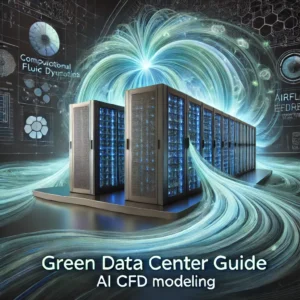
Although CFD analysis may be performed as part of the design and operational optimization of a data center, AI is beginning to play an increasingly important role in enhancing its efficiency and predictive capabilities. AI can begin to understand how design changes, equipment placement, or modifications to airflow and water-cooling systems can impact the overall thermal performance of a data hall. This advancement allows designers and engineers to make smarter, data-driven decisions that lead to better energy efficiency, lower cooling costs, and reduced environmental impact.
The Challenge of Traditional CFD Simulations
CFD modeling is a sophisticated process that involves solving mathematical equations governing fluid motion, heat transfer, and thermodynamics. Engineers must define various boundary conditions, such as:
- Server Heat Loads – The amount of heat generated by IT equipment in the data hall
- Airflow Distribution – The movement of cooled and heated air through containment systems and raised floors
- Cooling Unit Placement – The positioning of CRAC (Computer Room Air Conditioning) or CRAH (Computer Room Air Handler) units
- Water Flow Dynamics – How chilled water moves through cooling loops in liquid-cooled environments
Once these parameters are set, CFD software runs simulations iterating through thousands of possible airflow and temperature variations. Given the complexity, it can take significant time to process a single CFD model. More challenging still, engineers typically perform multiple iterations, refining variables like airflow patterns, rack placement, and cooling system capacity to identify the most optimal design.
We may currently be seeing CFD iterations performed in a traditional manner, where many models are run at once, consuming extensive computational resources and taking a long time to produce meaningful results. Each iteration requires substantial processing power to solve Navier-Stokes equations governing fluid motion, and as the scale of data centers grows, these computations become even more demanding.
How AI Can Improve CFD Analysis
AI has the potential to transform this process by making it faster and more predictive. Instead of running every possible iteration, AI can analyze historical CFD results, real-world operational data, and machine learning predictions to eliminate unnecessary simulations. AI can:
- Predict Feasible Design Adjustments – Instead of blindly testing multiple configurations, AI can intelligently predict which changes in server layout, airflow control, or cooling strategies will lead to better thermal performance.
- Reduce CFD Processing Time – AI can refine which CFD iterations should be run, significantly cutting down on the number of simulations required.
- Optimize Air and Water Flow – AI models can predict the best airflow containment strategies, such as whether cold aisle or hot aisle containment is most effective for a given data center design.
- Adapt to Real-Time Conditions – AI can work in tandem with digital twin technology, continuously learning from live temperature and airflow data to refine CFD models dynamically.
AI may be able to step in with predictions that can either eliminate some iterations early or identify which will be the most valuable to run. By doing so, AI can act as an intelligent guide, helping engineers focus their efforts on the CFD simulations that provide the most insight, thus significantly reducing design and optimization timelines.
AI-Powered CFD Iteration and Optimization
One of the most promising applications of AI in CFD is predictive modeling. Rather than running all CFD simulations from scratch, AI can use machine learning techniques such as:
- Neural Networks – AI can train models based on past CFD results to predict airflow and cooling performance without running full simulations.
- Genetic Algorithms – AI can optimize designs by evolving CFD iterations, selecting the best-performing models, and refining them automatically.
- Reinforcement Learning – AI can experiment with different cooling configurations in a virtual environment, learning over time which approaches work best.
With AI-driven CFD, an iterative cycle that once took weeks could be reduced to days or even hours. Instead of engineers manually adjusting parameters and waiting for simulations to complete, AI can generate optimized design recommendations in real time.
Real-World Applications and Future Potential
Several leading data center companies are already exploring AI-enhanced CFD solutions to improve airflow modeling and cooling strategies. For example:
- Google DeepMind’s AI for Cooling – Google has used AI to improve the cooling efficiency of its data centers, reducing energy usage by up to 40% through real-time AI-driven control systems.
- Nvidia’s CFD Optimization with AI – Nvidia is incorporating AI-driven predictive modeling into its HPC (high-performance computing) cooling systems to reduce computational overhead.
- Digital Twin Integrations – AI-powered digital twins are being deployed in hyperscale data centers to continuously refine CFD models using live operational data.
By 2030, AI-driven CFD is expected to become the standard in data center design. Instead of relying solely on static simulations, AI-enhanced CFD will create self-learning, self-optimizing cooling environments that adapt dynamically to workload changes, seasonal variations, and new hardware deployments.
AI in the Building Industry
The design of AI data centers is becoming smarter with AI-driven solutions:
- Predictive Maintenance: AI detects potential failures in infrastructure before they occur, improving building longevity.
- Automated Planning: AI optimizes project timelines, resource allocation, and cost estimation.
- Sustainable Material Selection: AI suggests materials that minimize carbon footprint and maximize energy efficiency.
As AI-driven design tools become more sophisticated, they are increasingly being used to optimize material selection for sustainability in data center construction. AI can analyze vast databases of materials, comparing their environmental impact, cost, durability, and carbon footprint. This enables architects and engineers to make more informed choices that align with sustainability goals.
For example, AI can suggest low-carbon concrete alternatives, recycled steel, and biodegradable insulation materials that reduce a data center’s overall environmental impact. Additionally, AI can factor in the supply chain logistics, recommending materials sourced locally to minimize transportation emissions and ensure faster project completion.
Beyond material selection, AI is revolutionizing how sustainable materials are integrated into the structural, mechanical, and thermal aspects of data centers. AI-driven simulations can assess the long-term performance of different materials in various climate conditions, ensuring they contribute to energy efficiency and longevity. For instance, phase-change materials (PCMs) can be incorporated into walls to regulate internal temperatures naturally, reducing cooling loads.
AI can also optimize the use of modular construction techniques, ensuring that prefabricated, high-efficiency building components are utilized to minimize waste. As AI continues to enhance material intelligence, data centers will move closer to achieving zero-waste construction and true circular economy principles, where materials can be reused or repurposed at the end of their lifecycle.
Future Improvements by 2030
By 2030, AI is expected to play an even greater role in architectural and data center design. Future developments may include:
- AI-Driven Design Assistants – Virtual AI architects that can collaborate with human designers in real time.
- Automated Code Compliance Checks – AI will ensure that all designs meet the latest energy efficiency and sustainability regulations.
- Real-Time Environmental Adaptation – AI-powered CAD tools will integrate live sensor data to make on-the-fly design modifications for optimal efficiency.
- Enhanced 3D Printing and Modular Construction – AI-generated designs will be seamlessly translated into prefabricated modular components for faster data center construction.
The convergence of AI and data center design is only beginning. As AI models become more sophisticated, future data centers will be entirely self-optimizing, adjusting cooling, power, and network configurations dynamically. AI will not only shape how data centers are designed but also how they operate in real time.
By embracing AI-driven design, companies can build more sustainable, energy-efficient, and resilient data centers capable of handling the ever-growing demands of artificial intelligence.
References
- Google DeepMind AI Cooling Case Study: DeepMind Blog
- NVIDIA AI Infrastructure: NVIDIA Data Center Solutions
- AI and Data Centers Report: Uptime Institute
- Amazon’s Pilot of AI-Designed Material for Carbon Removal: https://www.reuters.com/technology/artificial-intelligence/amazon-pilot-ai-designed-material-carbon-removal-2024-12-02/?utm_source=chatgpt.com
- NCAR-Wyoming Supercomputing Center’s Sustainable Practices: https://en.wikipedia.org/wiki/NCAR-Wyoming_Supercomputing_Center?utm_source=chatgpt.com (the supporting links can be found indirectly through searching on the respective sites)
- A Systematic Review of Applications of Generative Design Methods for Energy Efficiency in Buildings: https://www.mdpi.com/2075-5309/14/5/1311
- Core Scientific strategic shift: https://www.barrons.com/articles/core-scientific-stock-bitcoin-mining-ai-data-center-38b78b5e?utm_source=chatgpt.com