
As server densities rise and AI workloads drive higher power demands, advanced water cooling technologies have become essential to support deployments at the server, rack, and row levels. From chip-level liquid cooling to rear-door heat exchangers, flushing cooling loops play a vital role in maintaining operational efficiency, removing contaminants, and extending the lifespan of cooling equipment.
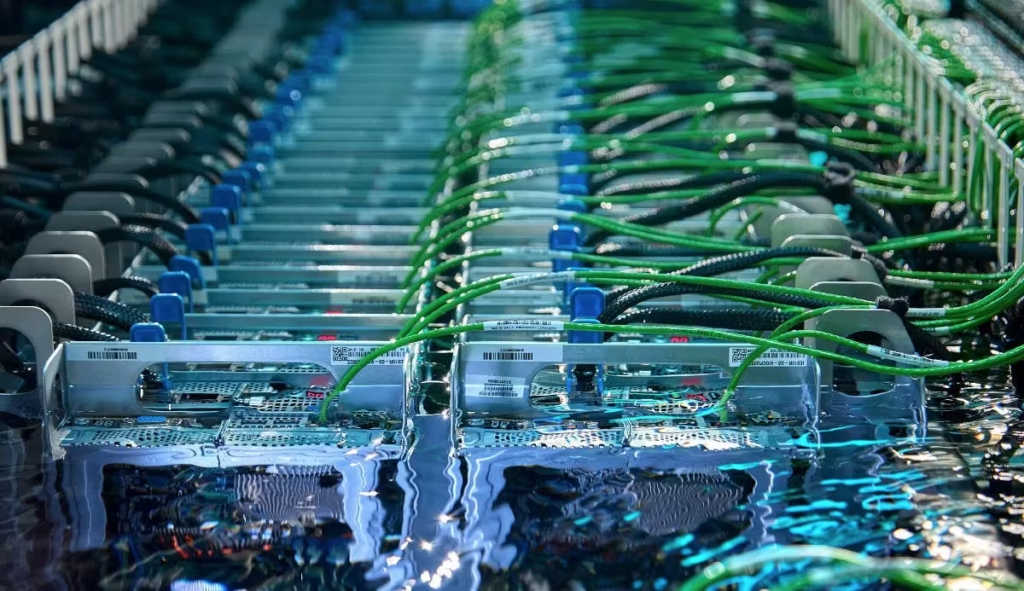
(Photo Credit: Data Center Frontier)
Why Flushing Technology Cooling Loops Matters
Flushing is the process of removing contaminants, corrosion byproducts, and micro-debris from a cooling loop to ensure optimal thermal performance. Residual particulates, microbial growth, and scale formation can degrade cooling efficiency, leading to higher energy consumption and potential system failures.
Flushing water loops in data center cooling systems is a critical process that ensures operational efficiency and longevity, from the start of the systems being operated. Over time, cooling water loops can accumulate debris, scale, and microbial growth, which hinder heat exchange efficiency and increase energy waste. Flushing removes these contaminants, both at the start and later as part of recommissioning, helping maintain consistent thermal performance and reducing degradation and the risk of system failures.
Key Benefits of Flushing:
- Prevents Buildup – Removes sediment and corrosion buildup from pipes and heat exchangers.
- Enhances Heat Transfer – Ensures efficient coolant flow and improves thermal conductivity.
- Extends Equipment Lifespan – Reduces wear on pumps, valves, and heat exchangers.
- Maintains Sustainability Goals – Helps meet LEED and ASHRAE standards for water treatment and efficiency.
There are several flushing methods used in data center cooling systems, depending on the severity of contamination and operational constraints. Chemical flushing involves using specialized cleaners to dissolve scale and biofilm buildup before flushing the system with fresh water. High-velocity flushing, on the other hand, relies on increased flow rates to dislodge particulates from pipes and heat exchangers. In some cases, filtration systems are integrated into the flushing process to continuously remove contaminants, improving the long-term cleanliness of the loop.
Environmental considerations play a significant role in flushing protocols, especially in sustainable data center operations. Wastewater management and proper disposal of cleaning agents must align with environmental regulations to minimize ecological impact. Some facilities opt for biodegradable cleaning solutions or implement advanced filtration technologies to reduce water waste. Optimizing water chemistry through controlled flushing cycles can minimize the need for excessive chemical additives while maintaining system integrity.
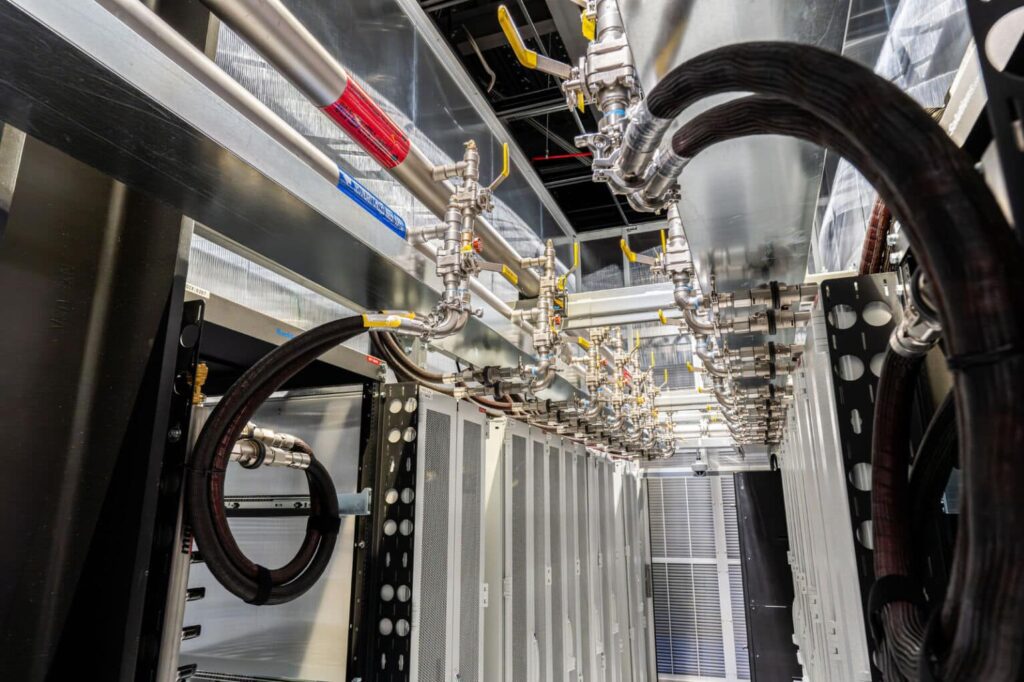
(Photo Credit: Equinix)
Flushing for Different Levels
Chip-Level Liquid Cooling
With the increase of direct-to-chip liquid cooling, flushing the microchannel cold plates is essential to prevent clogging and corrosion. High-purity water loops require low-conductivity fluids, making proper flushing critical to remove ionic contaminants.
- Best Practices: Use deionized water flushing and specialized filters to prevent micro-particle deposition.
Server and Rack-Level Cooling
Data center racks utilizing coolant distribution units (CDUs) rely on clean loops to ensure consistent flow rates. Unflushed loops can introduce pressure drops and uneven thermal distribution, leading to hotspots.
- Best Practices: Implement controlled turbulence flushing (Re > 4000) to ensure uniform removal of scale deposits.
Rear-Door Heat Exchangers
Rear-door cooling loops, which remove heat directly from server exhaust, demand stringent water quality control to prevent coil fouling.
- Best Practices: Deploy inline particle separation units and biocide treatments to prevent bacterial growth.
Row-Level Liquid Cooling
Flushing becomes critical in rear-door and sidecar heat exchanger configurations, where heat is dissipated efficiently at the row level. Water-cooled row-based solutions operate at higher flow rates, requiring periodic system purging to maintain cooling performance.
- Best Practices: Use closed-loop filtration and anti-corrosion additives to improve system longevity.
Advanced Flushing Technologies
Advanced monitoring systems that analyze water quality, flow rates, and thermal efficiency enable predictive maintenance and reduce the frequency of full-system flushes. By integrating automation and real-time diagnostics, operators can ensure peak performance while minimizing operational disruptions. P roper flushing and maintenance strategies ultimately contribute to energy efficiency, equipment longevity, and the sustainability of data center infrastructure.
To maximize efficiency, automated flushing systems have emerged, reducing maintenance downtime. These solutions integrate sensors for real-time water quality monitoring, tracking:
- Turbidity levels
- pH balance
- Conductivity & temperature drift
Maintaining clean and well-flushed cooling loops is paramount to efficiency and sustainability. Strategic flushing procedures ensure that cooling systems operate at peak performance, minimizing equipment failures and optimizing total cost of ownership (TCO).