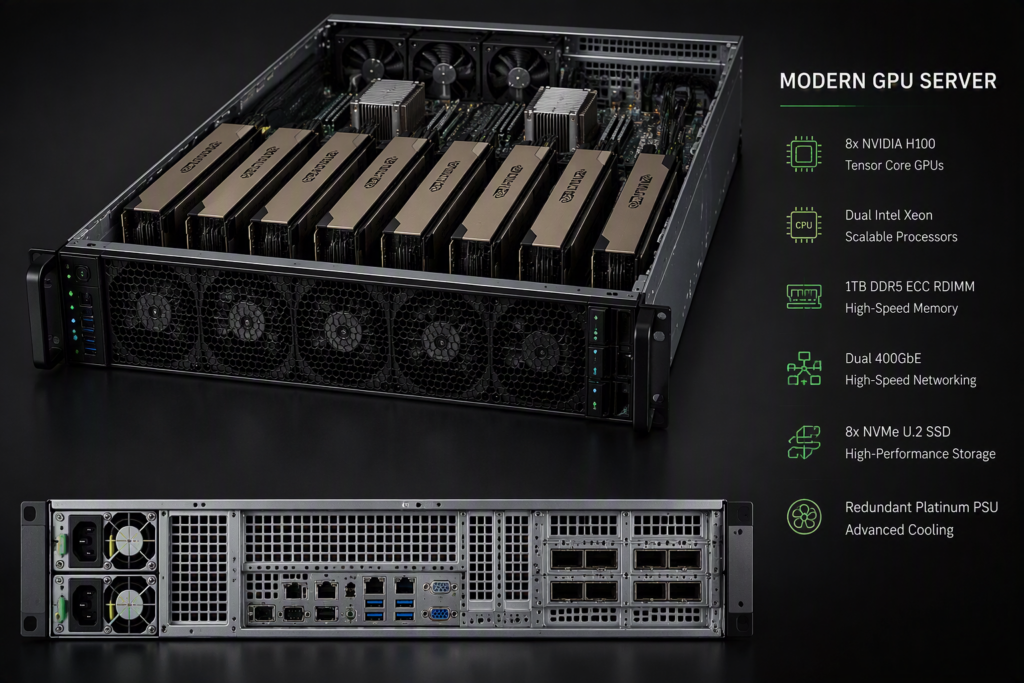
Maintaining the right humidity in a data center is a balancing act between preventing electrostatic discharge (ESD) and avoiding condensation or corrosion on sensitive electronics. ASHRAE TC 9.9 remains the primary standards reference for data center environmental envelopes; its Thermal Guidelines and related publications define allowable and recommended temperature and humidity bands for datacom equipment and are the baseline for specifying humidification performance. Equipment OEMs (server and GPU manufacturers) also publish environmental limits that should be checked during specification, because high density AI training clusters and modern GPU servers can impose different operational constraints than legacy IT gear.
Performance requirements
Start by defining the facility’s operational humidity band and the performance metrics the humidification system must meet. For mission‑critical facilities this typically means specifying a stable relative humidity (RH) band that minimizes ESD risk while avoiding moisture‑related failures; many operators target a narrow controlled band (for example, a 40–60% RH design band) informed by ASHRAE guidance and OEM limits, although this is typically a much wider range. Specify allowable transient excursions, maximum ramp rates, and dew‑point control tolerances so the control system can be tested and commissioned against measurable acceptance criteria. Include requirements for response time, control resolution (e.g., ±1% RH), and redundancy (N+1 or 2N) where uptime is critical. Cite ASHRAE TC 9.9 and OEM environmental specs when defining minimums and allowable ranges.
Technology tradeoffs
Humidifier selection should be driven by the facility’s humidity gap (how much moisture must be added), thermal budget, water‑quality constraints, and maintenance model. Common unit types and their tradeoffs are:
- Isothermal steam humidifiers (electrode, resistive, boiler) — fast, precise, and widely used in mission‑critical sites; however, they add sensible heat to the space, increasing cooling load and affecting PUE. Best where rapid RH recovery and precise control are required.
- Ultrasonic humidifiers (piezoelectric/diaphragm) —energy efficient and do not add heat; require high‑quality water and careful maintenance to avoid mineral aerosol. Good for moderate capacity needs where heat addition is undesirable.
- Adiabatic systems (high‑pressure fogging, evaporative media, atomizing nozzles) — low energy use and can provide evaporative cooling benefits, but depend on sufficient airflow and water quality; risk of droplet carryover must be mitigated by proper nozzle selection and placement.
- Centrifugal and other mechanical atomizers — simpler, robust options for smaller installations but less common in hyperscale deployments.
When specifying, require water treatment and filtration (deionization, reverse osmosis, or softening as appropriate), a maintenance plan for nozzle and tank cleaning, and monitoring for total dissolved solids (TDS) or conductivity where ultrasonic or adiabatic systems are used. Vendor whitepapers and industry guides provide practical selection matrices and lifecycle cost comparisons.
Standalone units versus in‑duct or in‑unit placement
Humidifiers can be standalone room units, in‑duct/air‑handler mounted, or integrated into precision cooling units (CRAC/CRAH). Each placement has implications:
- Standalone (unitary) humidifiers are flexible and can be staged to match load; they are often used for retrofit projects or where localized control is needed. They simplify service access but require careful airflow planning to ensure humidified air reaches server intakes without creating wet surfaces.
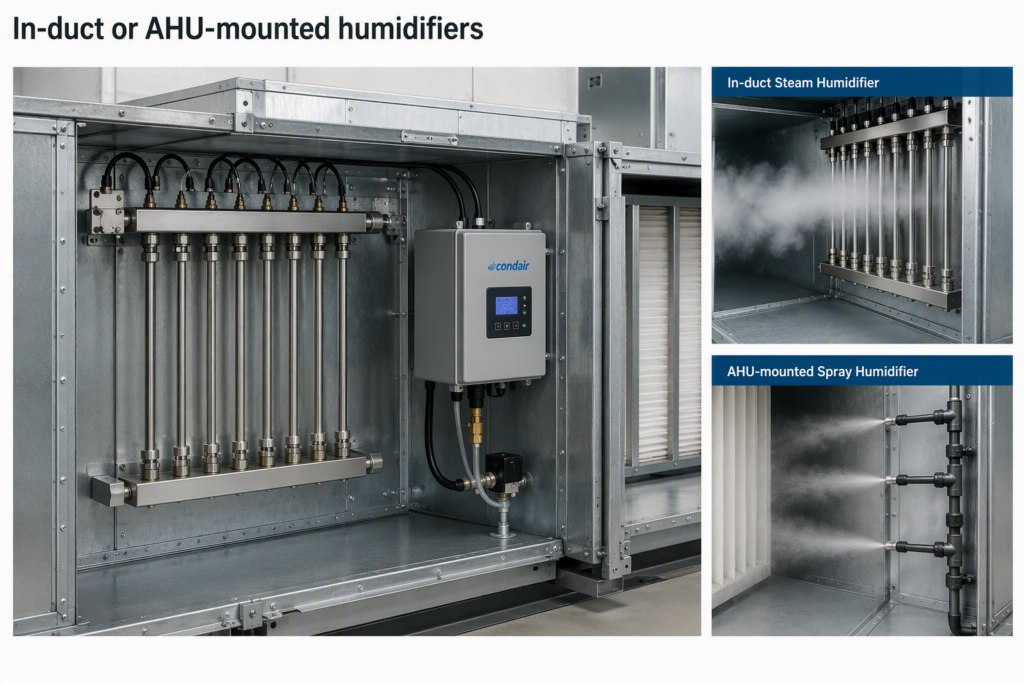
- In‑duct or AHU‑mounted humidifiers deliver moisture into the airstream upstream of the data hall and are effective when integrated with the HVAC control strategy; they reduce the risk of local wetting but require ductwork capacity and coordination with airflow and cooling loads. Specify non‑wetting atomization and droplet size limits to avoid carryover.
- Integrated modules in CRAC/CRAH or in‑row units simplify installation and controls and can be attractive for new builds; however, integrated units may have capacity limits compared with standalone systems and can concentrate failure modes if not properly redundant.
For AI inference and training clusters, where rack power densities and localized heat loads are higher, consider distributed humidification (in‑row or localized units) to avoid long transport paths for humidified air and to maintain tight control at the point of use. Also evaluate interactions with liquid‑cooling systems: liquid cooling can create cold surfaces and localized dew‑point risks, so humidification control must be coordinated with coolant temperatures and containment strategies.
Controls, integration, and monitoring
Specify a control architecture that ties humidifiers into the building automation system (BAS) and the data‑center infrastructure management (DCIM) platform. Key control features to require:
- Dew‑point control as the primary control variable (preferred over RH in many designs) to avoid condensation risk.
- Multiple sensor locations (aisle inlets, return plenums, and representative rack locations) with sensor redundancy and calibration schedules.
- Interlocks with cooling systems to prevent humidification when supply air temperatures or dew points could cause condensation.
- Alarms and trending for humidity, water quality, and unit faults; remote diagnostics and automated staging for multi‑unit systems.
Commissioning should include functional tests for control accuracy, response time, and failure modes (loss of water, power, or control signal). Require sensor calibration certificates and a maintenance plan in the specification.
Reliability, safety, and maintainability
Humidification systems introduce water into an environment that must remain dry at the component level. Specify non‑wetting delivery, droplet size limits, and placement rules to avoid direct wetting of racks, cable trays, or electrical equipment. Include water leak detection in raised floors and under critical equipment, and require service access and spare‑parts provisioning (nozzle kits, electrodes, ultrasonic transducers). For steam systems, include condensate management and pressure‑safety devices; for adiabatic systems, include anti‑microbial measures and water treatment to prevent biological growth.
Special considerations for AI inference and training environments
AI training clusters often run at sustained high power and can create hotspots and steep local humidity gradients. When designing humidification for these environments:
- Model the moisture distribution alongside thermal CFD to ensure humidified air reaches GPU intakes without creating condensation on cold plates or liquid‑cooling interfaces.
- Tighten control tolerances where GPUs or liquid‑cooled racks have narrow allowable dew‑point margins; reference OEM environmental specs for each GPU/server family.
- Plan for staged capacity: training workloads may be bursty and concentrated, so humidification systems should be able to ramp quickly or be staged to match load.
- Coordinate with liquid‑cooling systems to avoid cold surfaces below room dew point; where liquid cooling is used, dew‑point control and localized humidity sensing are essential.
Standards and references to include in specifications
When writing contract documents or technical specifications, reference the following standards and guidance documents as minimums and for testable acceptance criteria:
- ASHRAE TC 9.9 — Thermal Guidelines for Data Processing Environments (and subsequent updates) — primary guidance for allowable and recommended temperature and humidity ranges.
- Equipment OEM environmental specifications (NVIDIA, HPE, Dell, etc.) — use these to set minimums for new GPU and server families; where OEM limits are stricter than ASHRAE, the OEM limits govern.
- Vendor technical whitepapers and product literature (Condair, DriSteem, Carel, Munters, etc.) — for technology‑specific performance, water‑quality requirements, and maintenance guidance.
Include explicit language in the specification requiring compliance with ASHRAE TC 9.9 ranges, listing the exact RH or dew‑point band, allowable excursions, sensor locations, calibration intervals, and commissioning tests. Require submittals that show how the proposed humidification solution meets these criteria and how it will be integrated with the cooling and control systems.
Acceptance testing and commissioning
Define measurable acceptance tests in the contract: sensor accuracy verification, control loop stability tests, staged load tests (simulate humidification demand from idle to peak), and failure‑mode tests (loss of water, power, or BAS signal). Require a commissioning report that documents sensor calibration, control tuning, and a 24–72 hour stability run demonstrating the system can hold the specified band under representative IT loads.
Closing recommendations
- Start with ASHRAE and OEM limits: use ASHRAE TC 9.9 as the baseline and defer to OEM environmental specs where they are more restrictive.
- Match technology to operational needs: choose steam for precision and fast response, ultrasonic for energy efficiency where water quality can be assured, and adiabatic for large‑scale, energy‑sensitive deployments—always specifying water treatment and droplet control.
- Integrate controls and commissioning: require dew‑point control, multiple calibrated sensors, BAS/DCIM integration, and rigorous commissioning tests to validate performance under AI training and inference loads.